
Searching Evangeline Parish Civil Dockets
Serious civil, family, and succession cases in Evangeline Parish land in the Thirteenth Judicial District Court. The official website of the Evangeline Parish Clerk of Court points record seekers to Cott eSearch. That service sits behind an account login. It shows Good Thru Dates. Treat it as an index and image route for civil records. It is not a live docket register. For an inspected file, a minute entry, a pleading, an order, a judgment, or a certified copy, the clerk's office is the direct route.
Pull a caption together before you search. Grab the court and the rough filing date. Add the civil docket number if you have it, plus the division or judge from any court paper. Cott's public screen shows no party or civil-number fields until you log in. The eClerksLA/LCRAA portal offers statewide and parish search routes through participating clerks. It does not promise a public hit for every Evangeline Parish civil category. When nothing turns up online, call the clerk and ask which record channel applies.
- Confirm the court named on the petition, notice, judgment, or other civil paper.
- Use the parish clerk's public-record route and review Good Thru Dates before purchasing Cott access.
- Search only with fields the account actually exposes, because public Cott materials do not verify a civil search form.
- Call 337-363-5671 or inspect the district file at the clerk's counter when the docket or document is not available online.
- Request the actual pleading, order, or judgment when a docket line does not answer the question.
Evangeline Civil Divisions A and B
Local rules for the 13th JDC split district civil cases between Divisions A and B. That split holds for good. The clerk allots each case at random. It is a filing and records detail, nothing more. Nobody gets to pick a division. The division printed on a court paper helps the clerk pull the right civil docket, and it helps a reader tell a district file apart from a city or JP matter. The same rules cover local civil scheduling and pretrial materials.
The official 13th JDC appendices lay out the division structure and the local civil forms. A judge change or a later signed order can matter more. It can outweigh the first paper in the file. So an older notice is never the last word on a civil setting.
Note: Random allotment is a clerk process for district civil cases only. It does not pull a Ville Platte or JP filing into the 13th JDC docket.
Inside an Evangeline Parish Civil Docket
No public live sample exists without Cott access. Even so, the 13th JDC pretrial-order form confirms the local scheduling fields. It names the plaintiff, defendant, court, parish, judge, civil docket number, pretrial date and time, party claims, established facts, contested facts, and signature lines. That is what a local scheduling record can hold. Not every Evangeline Parish docket screen shows every field or document image. Read what is actually there.
| Caption | Identifies the plaintiff and defendant, whose roles should not be confused with the party filing a later motion. |
|---|---|
| Civil docket number | The clerk's civil identifier, displayed locally as CIVIL DOCKET NO. 82377 in one verified public example, not as a universal format. |
| Court and parish | Shows the 13th Judicial District Court and Evangeline Parish on the local pretrial template. |
| Judge and division | Connects the case to the A or B district-court assignment and the presiding judge. |
| Scheduling details | Can state pretrial conference date, time, claims, established facts, and contested facts. |
A docket lists activity in time order. For what the court actually decided, go to the signed judgment, order, or pleading. That document carries the real text.
Evangeline CIVIL DOCKET NO. Field
The 13th JDC pretrial form confirms "CIVIL DOCKET NO." as a local label. Use it when you talk with the Evangeline Parish clerk. It separates a civil court identifier from a citation number or a recorded land-instrument reference. One public legal notice carried the numeric example 82377. The court has published no such rule. Nothing says every civil case number runs five digits, carries a prefix, or follows a year pattern. Repeat the number as printed.
- Civil docket number
- The clerk's identifier for the civil court matter, shown on the local pretrial form.
- Motion
- A party's request for a court ruling; it is not itself a judgment.
- Order
- A judge's directive that is filed in the court record.
- Judgment
- A ruling that resolves an issue or the case, subject to later filings or appellate review.
The best civil lookup pairs the docket number with the right court, the party names, and the latest filed paper. That keeps you from reading an earlier motion as the final result. Motions are requests, not rulings.
Civil Case Types on the Docket
The district civil docket in Evangeline Parish carries major civil disputes. It also holds family matters and successions. A typical civil case runs from petition and service to answer or exception. Then come motions and notices of hearing. Pretrial work follows, then a ruling or trial, a signed judgment, and sometimes collection or appeal after that. The case category and the venue on the pleadings decide the record route. A parish-wide label does not stuff every civil dispute into one court.
| Record type | Likely local custodian | Important limit |
|---|---|---|
| Major civil, family, or succession matter | Evangeline Parish Clerk for 13th JDC | Confirm the division and current case status with the clerk. |
| Limited civil matter | Named JP court or Ville Platte City Court, depending on jurisdiction | The lower court keeps its own docket. |
| Municipal ordinance or utility-debt matter | Mayor's court or municipality where authorized | Not a general civil docket at the parish clerk. |
A Civil Docket Search finds the path to a case. The filed record holds the full document history and the ruling language.
1,435 Evangeline Civil Filings
The Louisiana Supreme Court's 2025 annual report counted 1,435 civil filings for District 13 in Evangeline Parish. That figure covers the district civil table alone. City, JP, and mayor's court matters sit outside it. The practical point is simple: name the court first. Lower-court civil files stay with their own custodian even when the parties live in the parish.
These numbers help size up the district workload. They say nothing about the answer in any one civil docket. For current entries, the Evangeline Parish clerk remains the source.
Civil Docket Settings and Hearings
A civil setting in Evangeline Parish is more than a date on a line. The local Rule 9.14 pretrial form captures the judge, the time, and each party's claims. It also records the facts both sides accept, the facts they dispute, and what still needs doing before trial. Under the rules, a fixing for trial or hearing can happen any day of the week. It can come by letter or by motion. The court posts no public daily hearing calendar and no setting-search form. The clerk and the latest court record are how you confirm what stands.
Read the newest signed scheduling order or minute entry first. Do this before trusting a notice of hearing. A motion or a service entry often shows up in the docket before the final schedule does. When a matter is continued, the old setting stays in the docket history. A later minute or order sets the new date. So call the clerk and give the civil docket number. Ask for the current setting, plus the division or judge if you know it.
Note: The pretrial template shows what fields Evangeline Parish civil settings use. But it is not a live calendar. It cannot prove every current hearing date.
Evangeline Major and JP Civil Dockets
Justice of the peace courts across Evangeline Parish cover Wards 2A, 2B, 3, 4, and 5. Their work is limited civil matters and committing-magistrate duties. Louisiana Revised Statutes 13:2586 bars JP courts from hearing succession, probate, and title-to-real-estate cases. No published dollar cutoff applies to JP jurisdiction. Check the court and the statute before filing. Ville Platte City Court also holds limited civil jurisdiction and keeps its own separate docket.
The Louisiana Attorney General Justice Court directory lists the ward-specific offices and is the official place to start. It can steer a lower-court civil question to the right office. It is not, though, a unified Evangeline Parish civil docket search.
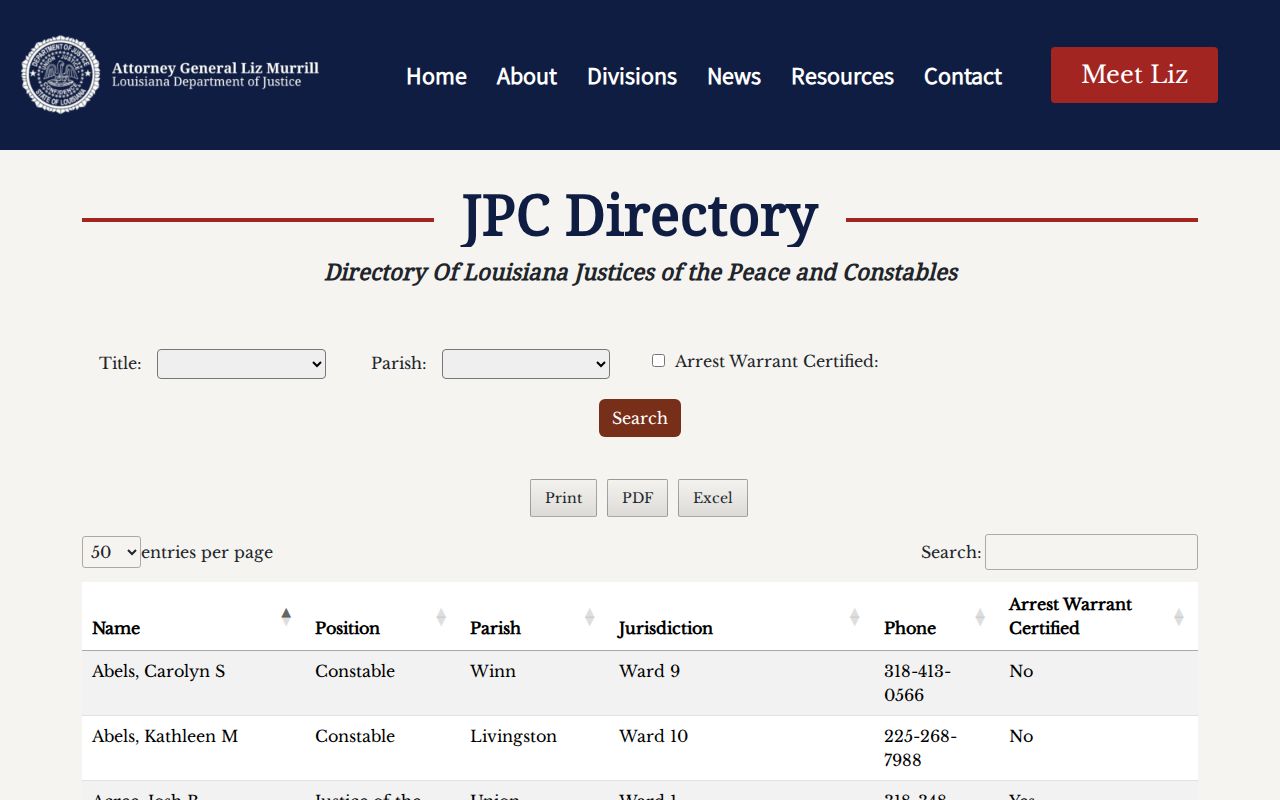
That directory page shows the JP-court route as its own track. A succession or title dispute should never land on a JP civil docket just because it arose in Evangeline Parish.
Civil Docket Access Rules
For an Evangeline Parish district civil record, Louisiana Code of Civil Procedure art. 251 applies. That article puts the clerk in charge. The public may examine and copy records during office hours unless a law limits access, and the clerk can issue certified copies under the court seal. The counter sits at 200 Court Street, Suite 104, Ville Platte, open weekdays from 8:00 a.m. to 4:30 p.m. A phone request, an in-person visit, and the Cott or eClerks route each serve a purpose. They are not interchangeable guarantees of the same material.
Records access: Article 251 covers clerk custody, inspection, copying, and certified copies. La. R.S. 44:31 recognizes inspection and copying rights subject to exceptions and places the burden for withholding on the custodian. Sealed, juvenile, and protected material can remain unavailable or redacted.
No official source publishes the exact Evangeline Parish fees for plain or certified court copies, the accepted payment methods, or turnaround times. Ask the clerk for the current amount before ordering a document.
Evangeline Civil Search With No Image
When Cott eSearch returns no civil image, start with the Good Thru Dates. Confirm the record belongs to a 13th JDC file and not a city or JP case. The Cott terms warn that indexed data can be incomplete or unverified while processing. Official records stay with the jurisdiction. A civil case may also be older paper material. Restricted material is another reason. Some categories have no established online coverage. None of that means a missing image signals a civil judgment or a dismissal.
For a district request, reach the Evangeline Parish clerk by phone, mail at P.O. Box 347, fax, email, or the official contact form once you confirm what the office accepts. Name the court, the docket number or caption, and the document you need. Give the date range. Say whether you want a plain or certified copy. The clerk contact page lists the published channels. The clerk supplies the current fee and delivery details.
Anyone tracking a civil appeal needs more. Pull the separate appellate record at the Louisiana Third Circuit. An appeal-related entry can appear in the Evangeline Parish file. Even then, the trial docket stays with the clerk.